About the Hackathon
# Reactive Bounties 2.0
Reactive Network is running a focused bounty program for hackers who can execute a well-specified use case with production-grade quality. We publish one concrete task at a time [here](https://dorahacks.io/hackathon/reactive-bounties-2/bounties); you ship the best implementation.
## Who this is for:
- Hackers who build to a spec and deliver reusable code
- Anyone applying Reactive Contracts to real, concrete flows
- Builders who value quality, security, tests, and maintainability
## How it works
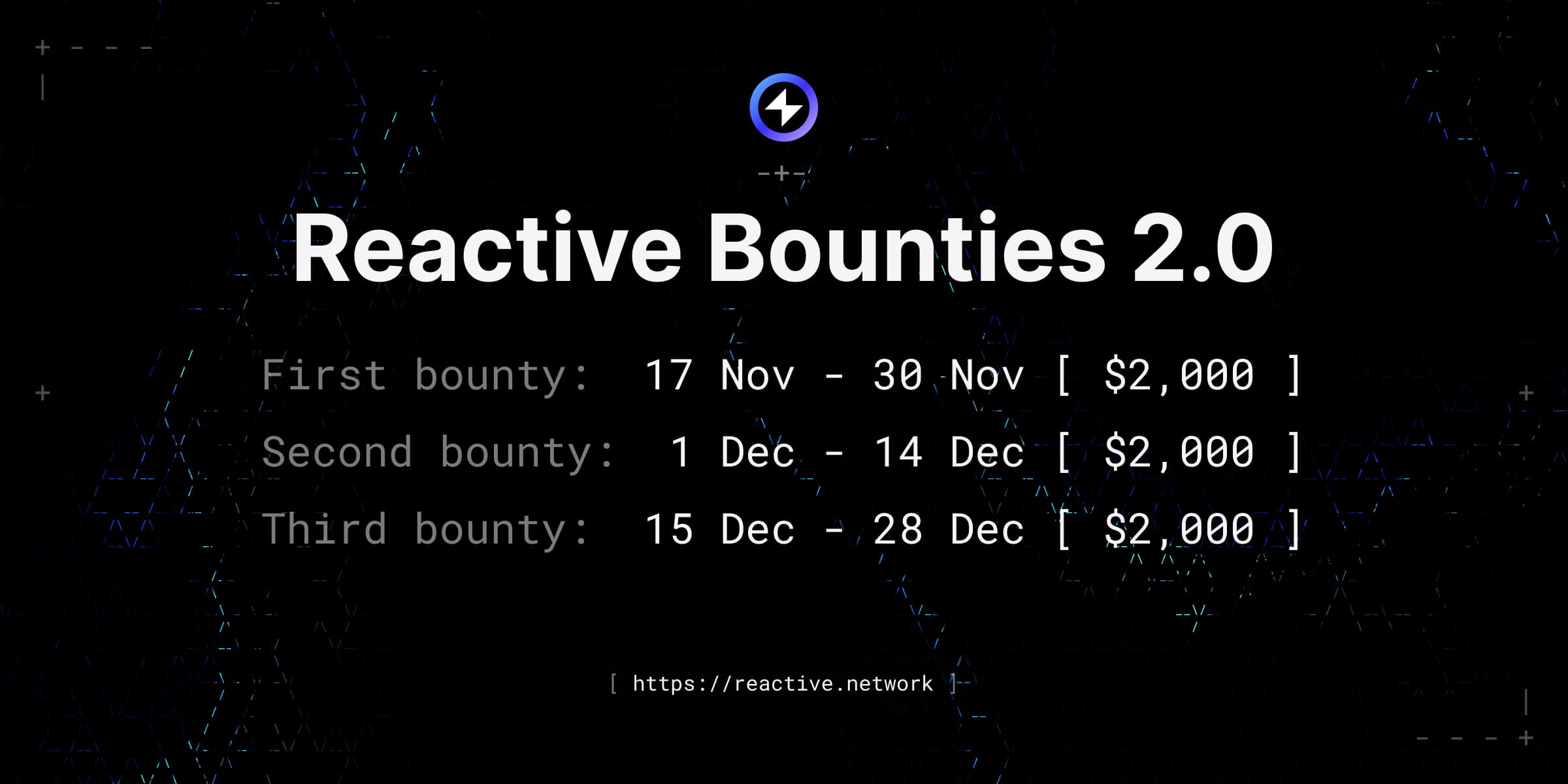
- One track, three bounties total
- Each bounty runs for 2 weeks
- We announce a precise use case and requirements for each bounty
- Each bounty is judged independently with its own winner and runner-up
## What you build
- See the list of bounties here and apply for the one that is currently running: [https://dorahacks.io/hackathon/reactive-bounties-2/bounties](https://dorahacks.io/hackathon/reactive-bounties-2/bounties)
- Implement the provided use case with Reactive Contracts and any supporting contracts/services
- Testnet deployments are allowed (mainnet not required)
- Focus on correctness, security, edge cases, and clean architecture
## Deliverables
- Working dApp or service deployed on Reactive testnet or mainnet and any of the other EVM chains or Ethereum Sepolia testnet
- Public GitHub repo
- Clear README with setup, deploy, and run instructions
- Short write-up or a 3–5 min video explaining design, threat model, and trade-offs
- Tests covering core logic and edge cases
- IMPORTANT! Step-by-step description of the workflow with transaction hashes for every step.
- Contract and deployment addresses
## Judging Criteria
A successful application MUST:
- Be submitted for a specific bounty before its deadline and fullfill its requirements, the list of bounties can be found here: [https://dorahacks.io/hackathon/reactive-bounties-2/bounties](https://dorahacks.io/hackathon/reactive-bounties-2/bounties)
- Utilize Reactive Contracts in a meaningful way. Simply deploying standard Solidity contracts on the Reactive Network is not enough. Your solution MUST incorporate reactivity—RCs should respond to EVM events and trigger transactions accordingly.
- It MUST be deployed on Reactive testnet or mainnet
- It MUST сontain the Reactive Contracts and Destination smart contracts, the deploy script, and the instructions for it.
- If the application uses its own Origin contracts, the repository MUST also include these contracts, along with their deploy scripts and instructions.
- It MUST contain the address of the Reactive Contracts deployed by the team.
- It MUST contain the addresses of the Origins and Destination smart contracts.
- It MUST contain a detailed explanation of the problem Reactive Contracts solve in that use case and why it is more difficult or even impossible to solve it without them.
- It MUST contain the step-by-step text description of how this setup works after being deployed.
- The team MUST run this workflow. The application MUST include the transaction hashes for every step of the workflow, for Origin transactions, Reactive transactions, and Destination transactions.
- The application MUST contain a presentation/demo video, no longer than 5 minutes. The video might contain slides, narration, app or code demonstration, depending on what the team finds more persuasive. The judges from Reactive team will watch the video/read pitch deck/write-up, as well as read the code and the docs.
The applications will be evaluated based on the following criteria:
- Code quality: clarity, modularity, tests, docs, readability
- Correctness and edge-case handling under realistic conditions
- Security: adversarial thinking, invariants, failure modes, mitigations
- Meaningful use of Reactive Contracts
- Operational maturity: deployment scripts, runbooks, reproducibility
## Prizes
For each bounty the prizes are $1,500 in native REACT for 1st place, $500 in native REACT for runner-up. Additionally, winners receive ecosystem visibility, tehcnial and marketing support from the Reactive team.
The winners of each bounty will be announced 1 week after the corresponding bounty deadline.
## Official support
- Primary channel: Telegram — [https://t.me/reactivedevs](https://t.me/reactivedevs)
- We answer spec questions, clarify edge cases, and point to relevant docs
## Getting started
- Education modules: [https://dev.reactive.network/education/module-1/reactive-smart-contracts](https://dev.reactive.network/education/module-1/reactive-smart-contracts)
- Code examples (use Stop Order as a scaffold if helpful): [https://github.com/Reactive-Network/reactive-smart-contract-demos/tree/main/src/demos/uniswap-v2-stop-order](https://github.com/Reactive-Network/reactive-smart-contract-demos/tree/main/src/demos/uniswap-v2-stop-order)
- Network and faucet info (testnet and mainnet): [https://dev.reactive.network/reactive-mainnet](https://dev.reactive.network/reactive-mainnet)
- Docs highlights:
- Subscriptions: [https://dev.reactive.network/subscriptions](https://dev.reactive.network/subscriptions)
- Events & callbacks: [https://dev.reactive.network/events-&-callbacks](https://dev.reactive.network/events-&-callbacks)
- ReactVM dual-state: [https://dev.reactive.network/reactvm](https://dev.reactive.network/reactvm)
- Economy: [https://dev.reactive.network/economy](https://dev.reactive.network/economy)
## Why Reactive
- Fully EVM-compatible execution layer for event-driven apps
- Reactive Contracts autonomously react to on-chain events and trigger cross-chain actions without user intervention
- Built for automation, DeFi, infra, and coordination logic