About the Hackathon
# 🚀 BUIDL with REACT
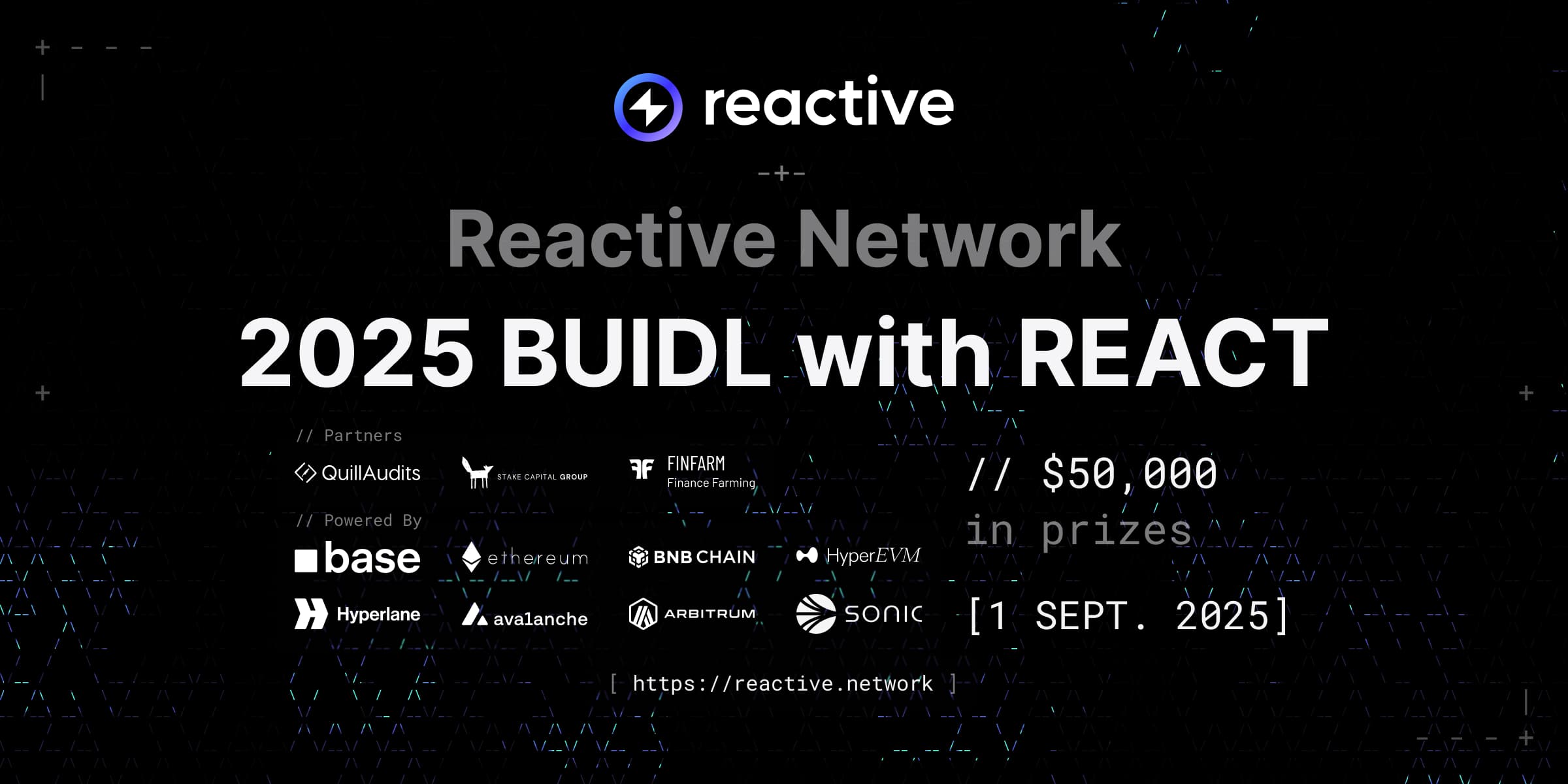
Welcome to the [BUIDL with REACT](https://reactive.network/buidl)! Reactive Network invites blockchain developers and startups who are already building a project to participate in our building competition. This event is your opportunity to innovate with your dApps using Reactive Network.
Reactive Network is at the forefront of blockchain evolution, offering a fully EVM-compatible execution layer that empowers developers to build the next wave of decentralized applications. Unlike traditional smart contracts, Reactive Smart Contracts autonomously react to on-chain events, driving interactions across multiple blockchains without user intervention.
# **👤Who This Is For**
- Developers or teams building any blockchain use case
- Anyone interested in experimenting with Reactive Smart Contracts
- Builders ready to ship to mainnet
# **⚙️How It Works**
### **Phase 1: Building Period (4 weeks). Sept 1 - 30**
Teams will build and deploy a working project using Reactive Smart Contracts. This can be in DeFi, infrastructure, DAOs, tooling—anything that makes sense with cross-chain automation or onchain logic.
Deliverables:
- Live dApp deployed to mainnet using Reactive
- GitHub repository
- Short write-up / pitch deck / video explaining the idea and implementation
💡 *Note:* dApps must be capable of running indefinitely, assuming they are sufficiently funded with REACT. This tests product durability and incentive alignment.
### **Phase 2: Usage Tracking (4 weeks). Oct 1 - 31**
We will start measuring on-chain usage during this period. It will be happening simultaneously with Phase 3 below.
### **Phase 3: Assessment Period.**
Projects will be evaluated based on these criteria:
- **60% Use Case & Longevity** (How useful, scalable, and sustainable the idea is)
- **40% Reactive Usage** (Number of transactions + REACT gas used)
We will announce winners at the beginning of November after the usage tracking is done.
# ⚡️Why Reactive?

## Reactive Smart Contracts
Autonomously react to blockchain events, automating complex financial instruments and DeFi applications. [Learn more](https://dev.reactive.network/reactive-smart-contracts)
## Start Building
To learn how to start building, visit our [documentation](https://dev.reactive.network/).
# 🏆 Prizes
- We’ll allocate a **$50,000 prize pool** to be distributed among the top-performing projects
- **Innovation Track (Main Track).** Prize sizes will **range from $1,000 to $5,000** depending on the quality of the submitted applications.
- Winner of the Innovation Track will also receive **$5000 in smart contract audit credits** provided by our partners, **Quill Audits** (see details below)*.
- **Rest of the tracks.** Prizes range from $200 to $500, based on the judging criteria outlined below.
- Remember that to be eligible for a prize in these tracks you MUST apply for the Innovation Track as well. Even if you don't receive a prize in Innovation Track, you are still eligible for the prizes in these tracks.
In addition to monetary prices, winners will receive:
- Marketing support
- Technical assistance
- Intros to VCs
- 20% off for audit services by QuillAudits
- Priority access to our $3M DeveloperFund and future accelerator/incubator programs
**$5000 in smart contract audit credits from Quill Audits. How it works: Covers 50% of costs with rest payable by the winner; Audit credits are redeemable for a single audit engagement covering up to 600 nLoC; If the audit scope exceeds the value of the pledged credits, the Winner shall bear the difference; The Winner must initiate the redemption process within 3 months of the event’s conclusion and complete onboarding within 6 months. The credits are non-transferable, non-refundable, and can only be used by the officially recognized Winner.*
# 💬 Official Communication Channel
We will mainly provide support on the official Reactive Network [Telegram](https://t.me/reactivedevs) channel.
# 📅 Key Dates
- September 1 (Mon) -- Start of the competition
- September 1 (Mon) -- Workshop I. Recording: [https://www.youtube.com/watch?v=S0gY1lra5xI](https://www.youtube.com/watch?v=S0gY1lra5xI)
- September 8th (Mon), 5PM UTC -- Workshop II. Watch here: [https://www.youtube.com/watch?v=MMEJyBpp854](https://www.youtube.com/watch?v=MMEJyBpp854)
- September 18th (Thursday), 2 PM UTC — Workshop III. Watch here: [https://www.youtube.com/watch?v=WJox52Q-F4s](https://www.youtube.com/watch?v=WJox52Q-F4s)
- September 30th (Tue) -- End of the competition
- Oct 1st - Oct 31st -- Usage monitoring period
- TBA -- Winners announcement
# 💪**Getting Started**
Below you can find the links to all the materials you will need to build on Reactive Network:
- First of all, feel free to join our Developer Chat ([https://t.me/reactivedevs](https://t.me/reactivedevs)) and ask any technical or use case questions.
- Take a look at our educational course (it’s pretty short) to grasp the basic concepts of what Reactive Smart Contracts (RSCs) are and what they can be used for: [https://dev.reactive.network/education/module-1/reactive-smart-contracts](https://dev.reactive.network/education/module-1/reactive-smart-contracts)
- However, if you already have a general idea, you might jump straight to the code examples. We recommend starting with Stop Order use case, you might even use it as a boilerplate project for your hackathon submission: [https://github.com/Reactive-Network/reactive-smart-contract-demos/tree/main/src/demos/uniswap-v2-stop-order](https://github.com/Reactive-Network/reactive-smart-contract-demos/tree/main/src/demos/uniswap-v2-stop-order)
- Below you will find our previous hackathon winners applications. Use them for inspiration and technical solutions, but don’t copy the use cases that have already been implemented: [https://dorahacks.io/hackathon/reactive-hackathon/winner](https://dorahacks.io/hackathon/reactive-hackathon/winner)
- See network and faucet information ([https://dev.reactive.network/reactive-mainnet](https://dev.reactive.network/reactive-mainnet) - the testnet is there, too). You can also ask us to send you some testnet REACT in our dev chat, if you don’t get enough REACT from the faucet.
- To understand the nuances better, take a look at our documentation. Basically, RSCs are almost like usual Solidity smart contracts, with the difference that their main purpose is reactivity. So, read a bit about subscribing to events ([https://dev.reactive.network/subscriptions](https://dev.reactive.network/subscriptions)) and reacting to events by sending callbacks ([https://dev.reactive.network/events-&-callbacks](https://dev.reactive.network/events-&-callbacks)).
- The last two important concepts are ReactVM dual-state environment ([https://dev.reactive.network/reactvm](https://dev.reactive.network/reactvm)) and paying for callbacks ([https://dev.reactive.network/economy](https://dev.reactive.network/economy)).
# **🔎Judging Criteria**
A successful application MUST:
- Utilize Reactive Smart Contracts in a meaningful way. Simply deploying standard Solidity contracts on the Reactive Network is not enough. Your solution MUST incorporate reactivity—RSCs should respond to EVM events and trigger transactions accordingly.
- It MUST be deployed on Reactive Mainnet
- It MUST be a live product which already can show some traction.
- It MUST сontain the Reactive Smart Contracts and Destination smart contracts, the deploy script, and the instructions for it.
- If the application uses its own Origin contracts, the repository MUST also include these contracts, along with their deploy scripts and instructions.
- It MUST contain the address of the Reactive Smart Contracts deployed by the team.
- It MUST contain the addresses of the Origins and Destination smart contracts.
- It MUST contain a detailed explanation of the problem Reactive Smart Contracts solve in that use case and why it is more difficult or even impossible to solve it without them.
- It MUST contain the step-by-step text description of how this setup works after being deployed.
- The team MUST run this workflow. The application MUST include the transaction hashes for every step of the workflow, for Origin transactions, Reactive transactions, and Destination transactions.
- The application MUST contain a presentation/demo video, no longer than 5 minutes. The video might contain slides, narration, app or code demonstration, depending on what the team finds more persuasive. The judges from Reactive team will watch the video/read pitch deck/write-up, as well as read the code and the docs.
The applications will be evaluated based on the following criteria:
- Whether Reactive Smart Contracts in this use case solve an important problem that could not be solved or could be solved less optimally without them.
- How clearly the use case is explained and justified.
- Reactive Usage – number of transactions and REACT gas used
- Code quality, security, readability.