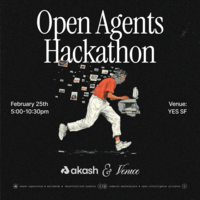
Akash Network — Hackathon
Open Agents Hackathon
This hackathon brings together developers, researchers, and builders to design and ship AI Agents trained on decentralized, open-source systems.
Prize Pool
Non-cash Prize
Location
Online
Duration
1 day
Date
Feb 24, 2026 - Feb 25, 2026
About the Hackathon
This hackathon brings together developers, researchers, and builders to design and ship AI Agents trained on decentralized, open-source systems.
Join Akash Network and Venice AI for a one-day hackathon focused on building the next generation of decentralized AI agents and open-source systems.This hackathon is for developers, researchers, and builders who believe AI should be open, composable, and permissionless — not locked behind centralized APIs.What You’ll BuildParticipants will build across two core tracks, both centered on decentralized AI agent infrastructure and open systems:Akash Agent Track:Create an autonomous or semi-autonomous AI agent deployed on Akash that continuously operates (not a one-off script) and is capable of task execution, monitoring, orchestration, or decision-making.The agent must take verifiable real-world actions such as authenticated API calls, multi-step tool usage, job scheduling, stateful resource management, or interactive user workflows — beyond simple prompt/response behavior.Demonstrate persistent state, fault tolerance, and compute independence by running the agent entirely on Akash Infrastructure (no fallback to centralized cloud compute), including redeploys or restarts without loss of core functionality.Outcome:Must be a working agent hosted on Akash Console and use a hosted model via the akashml API while meeting the criteria above.Venice TrackPrivate Multimodal IntelligenceVision, Voice, and Reasoning Under User ControlReal intelligence is multimodal.Modern AI systems combine language, vision, speech, and video to understand and act in the world.Most existing multimodal pipelines centralize this data in third-party cloud systems, creating long-lived records of highly sensitive user information.This track focuses on buildingmultimodal AI systemsthat deliver advanced capabilities while preserving user control over data and execution.ChallengeCreate applications that combine language, vision, speech, and video into coherent workflows while minimizing external data exposure and long-term retention.Projects should demonstrate how multimodal intelligence can operate with:Controlled data flowsMinimal retentionTransparent processingUser-owned storageWhat to BuildProjects may include:Voice-first agents with private visual perceptionSecure meeting and call assistantsLocal-first or hybrid perception pipelinesConfidential video understanding systemsPrivacy-preserving creative studiosMultimodal copilots for sensitive workflowsExample ProjectsAn AI assistant that summarizes meetings without storing recordingsA voice-controlled design studio with encrypted asset storageA video analysis system that avoids centralized raw footage storage
Event Details
Format
Online
Prize Pool
Non-cash Prize
Currency
USD
Start
Feb 24, 2026
End
Feb 25, 2026
Duration
1 day
Organized by Akash Network
Online · Ended
Timeline
Feb 24, 2026
EVENT STARTS
Hackathon kicks off. Join online and start building.
Feb 25, 2026
EVENT ENDS
Final submissions and judging period begins.